
Staircase Calculation Formula PDF: A Comprehensive Guide
Navigating staircase design demands precision, and a reliable PDF guide containing formulas is essential for both professionals and DIY enthusiasts. These documents consolidate crucial information, ensuring code compliance and structural integrity, referencing standards like the 2018 IBC and OSHA guidelines.
Staircase calculations are fundamental to safe and comfortable building design, requiring a precise understanding of geometry and building codes. A staircase calculation formula PDF serves as an invaluable resource, streamlining the process of determining optimal dimensions for rise, run, and overall staircase layout. These calculations aren’t merely academic; they directly impact usability and adherence to regulations set forth by organizations like the International Building Code (IBC) and the Occupational Safety and Health Administration (OSHA).
Understanding these formulas is crucial for ensuring that staircases meet minimum tread depth requirements (typically 11 inches according to the 2018 IBC) and maximum riser height limitations (around 7 inches for the same code). Ignoring these parameters can lead to hazardous conditions and potential legal issues. A well-structured PDF guide provides a centralized location for these formulas, alongside explanations and examples, making complex calculations accessible to a wider audience.
Understanding Key Staircase Terminology
Before diving into a staircase calculation formula PDF, grasping core terminology is paramount. Riser refers to the vertical height of each step, while tread denotes the horizontal depth. Going represents the total horizontal distance covered by the staircase, and run is the horizontal plane of a single tread. Headroom, a critical safety factor, is the vertical clearance above the staircase.
A comprehensive PDF guide will consistently utilize these terms within its formulas and explanations. Understanding the interplay between these elements is vital for accurate calculations. For instance, the IBC and OSHA standards dictate maximum riser heights (9.5 inches OSHA, 7 inches IBC) and minimum tread depths (9.5 inches OSHA, 11 inches IBC). A clear understanding of these terms, as defined within a reliable PDF resource, ensures correct application of the formulas and ultimately, a safe and compliant staircase design.

Riser
The riser, the vertical portion of a stair step, is a fundamental element in any staircase calculation formula PDF. Its height directly impacts the overall staircase incline and comfort. Building codes, such as those outlined in the IBC, impose a maximum riser height of 7 inches, while OSHA allows up to 9.5 inches.
A well-structured PDF guide will detail how to calculate the optimal riser height based on the total rise of the staircase and the desired number of steps. Incorrect riser height can lead to uncomfortable and potentially dangerous stairs. The formula often involves dividing the total rise by the number of steps. Consistent riser height across all steps is crucial for safety and code compliance, a point emphasized in any thorough staircase calculation formula PDF.
Tread
The tread, the horizontal surface of a stair step, is paramount for safe and comfortable ascent or descent, and a comprehensive staircase calculation formula PDF will dedicate significant attention to it. Building codes dictate a minimum tread depth; the 2018 IBC requires at least 11 inches, while OSHA specifies a minimum of 9.5 inches.
A detailed PDF guide will illustrate how tread depth influences the staircase’s ‘run’ and overall footprint. Calculating adequate tread depth involves considering the user’s stride and ensuring sufficient space for foot placement. The formula often centers around the total run divided by the number of steps. Consistent tread depth is vital, and a good PDF will highlight this, alongside warnings about the dangers of varying tread depths, which can cause trips and falls.
Going
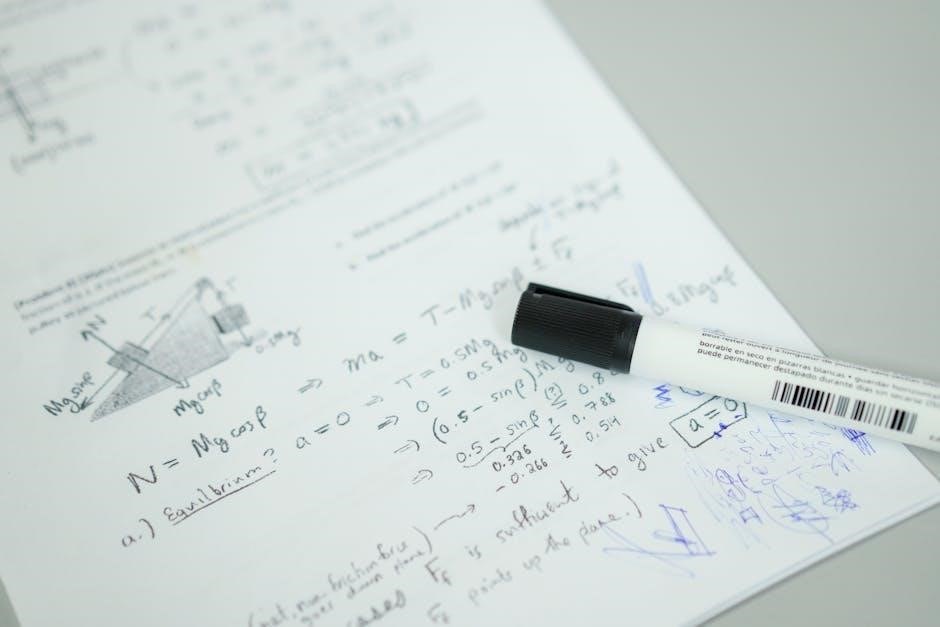
The ‘going’ of a staircase refers to the total horizontal distance the staircase covers, a critical measurement detailed within any thorough staircase calculation formula PDF. It’s fundamentally linked to the tread depth and the number of steps. Accurate going calculation is essential for ensuring the staircase fits within the designated space and meets building code requirements.
A comprehensive PDF guide will demonstrate how to determine the total going, often by measuring the horizontal distance between the lower and upper floors. This measurement, combined with the desired tread depth, allows for the calculation of the necessary number of steps. Understanding the relationship between going, tread, and rise is central to proper staircase design, and a well-structured PDF will clearly illustrate these connections, referencing standards like the IBC.
Run
The ‘run’ in staircase terminology, thoroughly explained in a staircase calculation formula PDF, represents the horizontal distance covered by a single step – specifically, the tread depth. It’s a vital component when ensuring staircase safety and adherence to building codes, such as those outlined by the IBC and OSHA.
A detailed PDF guide will emphasize the importance of the minimum tread depth, typically around 11 inches according to the 2018 IBC, though OSHA allows for 9.5 inches. Calculating the run accurately is crucial for comfortable and safe ascent and descent. The PDF will likely include formulas demonstrating how run impacts the overall staircase layout and the number of steps required, ensuring a functional and compliant design.

Headroom
A comprehensive staircase calculation formula PDF will dedicate significant attention to ‘headroom’ – the vertical clearance above the staircase, crucial for safety and comfort. This dimension, often overlooked, must meet building code requirements to prevent accidental head impacts during use.
PDF guides detail how to accurately measure and calculate necessary headroom, typically a minimum of 6 feet 8 inches, as referenced in building standards. The document will likely illustrate how headroom is affected by the staircase’s angle and the structural elements above. Proper headroom calculation, detailed within the PDF, is essential for ensuring a safe and legally compliant staircase design, avoiding potential hazards and code violations.
Building Codes and Staircase Dimensions (IBC & OSHA)
A thorough staircase calculation formula PDF will invariably emphasize adherence to building codes, specifically referencing the International Building Code (IBC) and Occupational Safety and Health Administration (OSHA) standards. These codes dictate acceptable parameters for staircase construction, ensuring safety and accessibility.
The PDF will likely detail the 2018 IBC stipulations: a maximum 7-inch rise and a minimum 11-inch run (tread depth). OSHA standards, often more stringent, may specify a maximum 9.5-inch rise and a minimum 9.5-inch run. A comprehensive PDF will present these regulations clearly, alongside diagrams and examples, to facilitate accurate calculations and compliant designs. Understanding these codes is paramount for legal and safe staircase construction.
Maximum Riser Height
A detailed staircase calculation formula PDF will prominently feature the maximum allowable riser height, a critical safety parameter. Building codes, such as the 2018 IBC, generally cap the maximum riser height at 7 inches. However, it’s crucial to note that OSHA standards can be more restrictive, potentially limiting this to 9.5 inches, depending on the application and jurisdiction.
The PDF should explain how exceeding this maximum can lead to uncomfortable and potentially dangerous ascents and descents. It will likely include formulas to calculate riser height based on total rise and the number of steps. Furthermore, a good PDF will highlight the importance of consistent riser height throughout the staircase for safety and code compliance.
Minimum Tread Depth
A comprehensive staircase calculation formula PDF will clearly define the minimum acceptable tread depth, vital for safe footing. The 2018 IBC building code stipulates a minimum tread depth of 11 inches. Conversely, OSHA regulations may require a slightly larger minimum, setting it at 9.5 inches, emphasizing worker safety in commercial settings.
The PDF should detail how insufficient tread depth increases the risk of slips and falls. It will likely present formulas for calculating tread depth based on total run and the number of steps. A quality guide will also stress the necessity of consistent tread depth across all steps, ensuring a uniform and secure walking surface, and adherence to building regulations.
Basic Staircase Calculation Formulas
A robust staircase calculation formula PDF will center around three core calculations: total rise, total run, and the number of steps. The Total Rise is the vertical distance from the floor to the landing, while Total Run represents the horizontal distance. A fundamental formula is: Number of Steps = Total Rise / Riser Height.
The PDF should illustrate how to derive these values from architectural plans. It will likely include formulas for adjusting these calculations based on desired step dimensions, ensuring compliance with building codes. Understanding these basic formulas is crucial for accurate staircase design, and a well-structured PDF will present them clearly with illustrative examples.
Calculating Total Rise
A comprehensive staircase calculation formula PDF will detail how to determine the Total Rise, which is the total vertical distance the staircase needs to cover. This is typically measured from the finished floor level of the lower story to the finished floor level of the upper story, or to the landing surface.
The PDF will emphasize accurate measurement, accounting for floor thicknesses and any landing heights. It will likely present the formula: Total Rise = Upper Floor Level – Lower Floor Level. Furthermore, it will explain how to verify this measurement against building code limitations, such as the maximum riser height stipulated by the 2018 IBC (maximum 7 inches) and OSHA (maximum 9.5 inches).
Calculating Total Run
A detailed staircase calculation formula PDF will guide users through determining the Total Run, representing the total horizontal distance the staircase occupies. This measurement is crucial for ensuring adequate space and comfortable ascent/descent. The PDF will likely present the formula: Total Run = Number of Steps x Tread Depth.

It will stress the importance of adhering to minimum tread depth requirements outlined in building codes – the 2018 IBC mandates a minimum of 11 inches, while OSHA requires at least 9.5 inches. The PDF will also explain how to account for any necessary overhang or extension beyond the structural support, ensuring a safe and compliant design. Accurate calculation is paramount for a functional staircase.
Determining the Number of Steps
A comprehensive staircase calculation formula PDF will detail how to calculate the Number of Steps needed for a safe and comfortable staircase. This is typically derived from the Total Rise (vertical height) and the chosen Riser Height. The core formula presented will be: Number of Steps = Total Rise / Riser Height.
The PDF will emphasize rounding up to the nearest whole number, as partial steps are impractical. It will also highlight the maximum riser height restrictions – 7 inches per the 2018 IBC, and 9.5 inches according to OSHA standards. Proper step count ensures compliance and user safety, preventing overly steep or shallow inclines. The document will likely include examples illustrating this calculation.
Staircase Formulas for Different Stair Types
A detailed staircase calculation formula PDF will differentiate formulas based on staircase configuration. While the basic Rise/Run principles apply universally, specific geometries demand adjusted calculations. Straight staircases utilize straightforward formulas for total run, number of steps, and angle of ascent, often detailed with diagrams.

Spiral staircases, however, require more complex trigonometric calculations to determine tread widths and radii, often referencing specific code requirements. Curved staircases present the greatest challenge, frequently relying on approximations or specialized software due to their varying radii and tread depths. The PDF will likely offer guidance on these complexities, emphasizing the importance of professional consultation for non-standard designs.
Straight Staircase Formula
A comprehensive staircase calculation formula PDF will prioritize the straight staircase due to its simplicity. The core formula revolves around Total Rise divided by Riser Height equaling the Number of Steps. Similarly, Total Run divided by the Tread Depth yields the same result. These calculations are foundational, ensuring consistent step dimensions.
Total Run is determined by multiplying the Number of Steps by the Tread Depth. A good PDF will illustrate these relationships visually. Crucially, it will emphasize adherence to building codes – the 2018 IBC specifies a maximum 7-inch rise and minimum 11-inch run, while OSHA allows a maximum 9.5-inch rise and 9.5-inch run. Accurate application of these formulas guarantees code compliance and safe staircase construction.
Spiral Staircase Considerations
A staircase calculation formula PDF addressing spiral staircases must acknowledge their complexity; Unlike straight runs, spiral stairs necessitate calculations accounting for the central supporting column and varying tread shapes. The Total Rise and Total Run remain fundamental, but their application differs significantly.
PDF guides will detail calculating the stair’s radius and the effective tread depth at the narrowest point – typically 9 inches minimum, per code. Headroom becomes a critical factor, demanding careful consideration. Building codes (IBC & OSHA) impose stricter limitations on spiral staircases, often restricting their use in primary egress routes. A detailed PDF will provide diagrams illustrating these geometric relationships and emphasize the need for professional consultation to ensure safety and compliance.
Curved Staircase Calculations ‒ Complexity & Approximations
A comprehensive staircase calculation formula PDF must address the challenges of curved staircases. These designs deviate from simple geometric formulas, requiring more advanced trigonometric calculations or specialized software. Determining the Number of Steps becomes intricate as tread lengths vary along the curve.
PDF resources often employ approximations, such as treating the curve as a series of short, straight segments for calculation purposes. However, these approximations introduce potential inaccuracies. Accurate Going and Run calculations are vital, alongside ensuring consistent Riser heights. Building codes (IBC) demand adherence to safety standards, even with curved designs. A detailed PDF will highlight the limitations of simplified methods and recommend professional engineering review for complex curves.
Headroom Calculation and Importance
A thorough staircase calculation formula PDF emphasizes the critical importance of adequate headroom. Headroom, the vertical clearance above the stair flight, directly impacts safety and usability. Insufficient headroom poses a significant risk of head injury, violating building codes (IBC & OSHA). PDF guides detail how to accurately calculate required headroom, typically a minimum of 6 feet 8 inches (81 inches).
Calculating headroom involves determining the total rise and accounting for the structural thickness of the floor above. The PDF should illustrate how to measure from the finished floor to the lowest point of any obstruction overhead. Proper headroom ensures comfortable and safe passage for all users. Ignoring this aspect can lead to costly rework and potential legal liabilities, making it a key component of any staircase design.
PDF Resources for Staircase Calculations
Locating comprehensive staircase calculation formula PDFs is crucial for accurate design and code compliance. Many online resources offer downloadable guides detailing essential formulas for various stair types – straight, spiral, and curved. These PDF documents often include detailed diagrams, clarifying complex calculations for rise, run, and headroom.
Commercial stair dimension standards are frequently available as PDF downloads from industry organizations like Lapeyre Stair, ensuring adherence to IBC building codes. PDF guides simplify navigating these regulations, providing clear explanations of maximum riser heights and minimum tread depths. Utilizing these resources minimizes errors and streamlines the design process, offering a valuable asset for professionals and DIYers alike, guaranteeing a safe and structurally sound staircase.
Free Online Stair Calculators & PDF Guides
Numerous websites provide free online stair calculators and downloadable PDF guides, simplifying staircase design. These tools automate complex calculations, determining the number of steps, total rise, and total run based on user-defined parameters. Many PDF resources consolidate essential formulas, referencing building codes like the 2018 IBC and OSHA standards for maximum riser height and minimum tread depth.

Lapeyre Stair and similar companies offer PDF guides detailing standard commercial stair dimensions, ensuring compliance and accessibility. These resources are invaluable for both professionals and DIY enthusiasts, offering a convenient way to verify calculations and ensure a safe, structurally sound staircase. Utilizing these free tools and PDF guides streamlines the design process and minimizes potential errors.
Commercial Stair Dimension Standards (PDF Downloads)
Accessing commercial stair dimension standards via PDF downloads is crucial for ensuring code compliance and safety. These documents, often referencing the IBC (International Building Code), detail specific requirements for tread depth, riser height, stair width, and headroom in commercial buildings. Lapeyre Stair provides resources outlining these standards, ensuring functional and accessible staircases.

PDF guides typically specify a maximum riser height of 7 inches (2018 IBC) and a minimum tread depth of 11 inches, though OSHA allows for a maximum riser height of 9.5 inches and a minimum tread depth of 9.5 inches. Downloading and carefully reviewing these PDFs is essential for architects, contractors, and building inspectors, guaranteeing adherence to legal requirements and promoting user safety within commercial spaces.